Articles

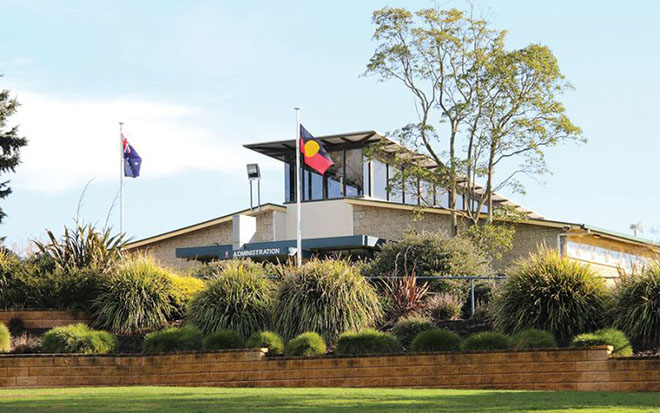
Islamic School of Canberra loses federal funds Following an internal review by the DET, the Islamic School of Canberra will lose its Commonwealth Funding effective 16 December. The decision, announced by Minister Simon Birmingham on Friday 27 October, upheld the original decision to revoke the authority’s approval under the Australian Education Act 2013.
Getting to know parents A friend who was employed in a large retail store for almost 20 years told me that the first lesson she learned from her manager when she started was “A lot of customers are sometimes right.”      She said this realisation made her able to deal effectively with the difficult customers, the impatient customers, the angry customers – as well as with the lovely ones.
MLC girls win in VIC Formula 1 STEM Challenge Three student teams from Melbourne's MLC have placed 1st, 3rd and 4th in the VIC regional competition. F1 in Schools in the world’s largest STEM competition, involving over nine million students who design, build, test and race miniature F1 cars.
Principals lose hiring freedom in WA Independent Public Schools Since 2010, IPS principals have had complete autonomy over staff selection, but under a change of direction ordered by Education Minister Sue Ellery, they will have to consider education department "redeployees" before hiring  teachers, support and admin staff.
Study investigates age when children start to regulate their learning A Uni QLD study led by Phd Student Melissa Brinums is helping parents and teachers understand the capacity of young children to learn independently, by providing insight into children’s understanding of practice. The study investigated the age at which children start to regulate their own learning to achieve their long-term goals.
Indigenous students failing to make the maths grade Indigenous students are eight times more likely to fall behind in maths by Year 9 than non-indigenous students, dampening regional innovation according to AMSI's 2017 Discipline Profile of the Mathematical Sciences.
Virtual puzzles can teach kids to solve real-world problems Swinburne researchers have shown that children can apply the skills they learn on a tablet to the real world. The research shows that when four to six-year-olds learn how to solve a puzzle using a tablet, they then apply this learning to the same puzzle in the physical world.
Digital devices add to exam time stress: Family Zone survey A survey of 1000 teenagers and their parents shows that electronic devices are causing sleep and study problems for teenagers as they come up to end of year exams. The survey, commissioned by cyber safety platform, Family Zone, found teenagers are being robbed of sleep in the lead-up to exams
2.5m maths activities completed in Mathletics Challenge Over 6000 schools from Australia, New Zealand and South Africa took part in the recently completed 2017 Mathletics Tri-Nations Challenge. 1.5 million students were registered for the event and completed over 2.5m maths activities. Over half of the students on the winners list were Australian.
Neil Bramsen and Brett Mckay receive Prime Minister's Prize for Excellence in Science Teaching The Prime Minister’s Prizes for Excellence in Science Teaching in Primary and Secondary Schools are awarded for excellence in teaching in any area of science that is part of the teacher’s state or territory science syllabus. The prize is awarded to teachers who have made an outstanding contribution to science education.
Notre Dame MA (Writing) to aid NSW teachers with English syllabus A new writing course introduced by The University of Notre Dame will equip NSW teachers to deal with major changes set to shake-up the English HSC syllabus next year. The new Master of Arts (Writing) program will play a key role in answering the professional development needs of English teachers
Confessions of an IT Manager It is clear that our students are moving into a workforce that is both unpredictable and precarious. With constant reminders that computers and automation will replace many jobs, we are being urged to ‘teach differently’. Schools are being challenged to create young minds that are rich in interpersonal skills, minds that are creative, collaborative, and above all, resilient.     What does this mean, and how can we achieve these objectives while addressing the needs of the curriculum